People, roles, and service groups
QIAS LIMS combines platform roles, organization membership roles, permissions, and service-group scope. Use the narrowest access that lets someone do their work.
Platform roles
Common operational roles include client, technician, trainer, consultant, reviewer, and LIMS administrator. A role enables a type of work; it does not automatically grant access to every job.
Service-group scope
Service groups control which operational area a staff member can see. For example, a technician assigned to the sample-analysis group can see jobs in that group but cannot work on out-of-scope training or consultation jobs.
When an assignment dialog lists no eligible staff member, verify:
- the job’s service-group mapping
- the person’s active platform role
- the person’s active service-group scope
- whether the person is disabled or support-read-only
Assigning delivery and validation work
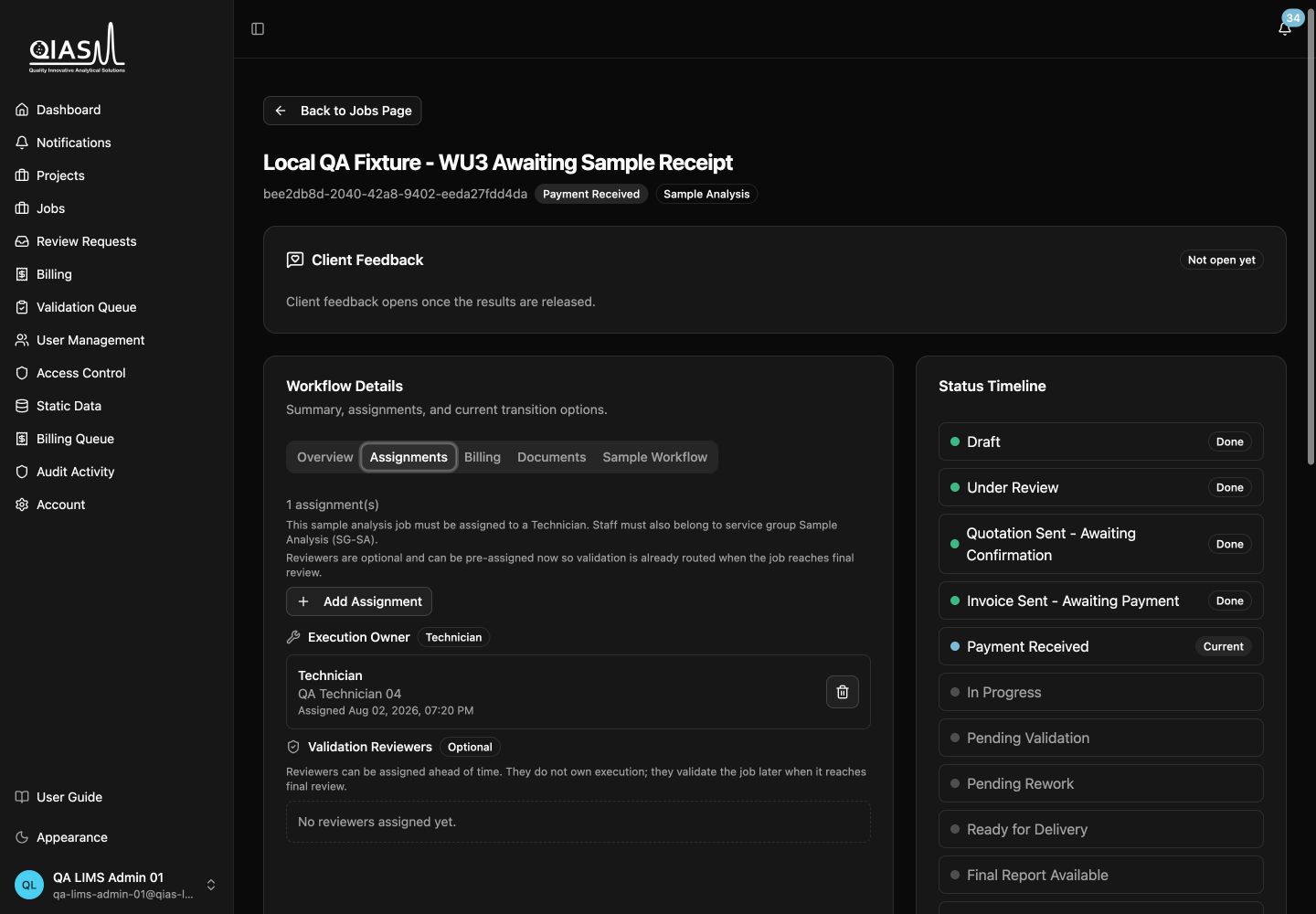
In the job assignment surface, treat these as two separate decisions:
- Execution Owner: technician, trainer, or consultant who does the work
- Validation Reviewer: reviewer who validates the delivered job later
Pre-assigning a reviewer is allowed and encouraged when it clarifies the quality-control handoff. It does not give the reviewer the execution-owner actions.
Client accounts and memberships
Use the client-account approval queue to review new organization and individual accounts. Manage account members and organization roles from the client account’s authorized surfaces. Only organization accounts have company identity fields such as company phone number, VAT number, CR number, and company logo.
Access control
Use Admin → Access Control for platform-role and permission management. High-risk permission changes should be made deliberately and reviewed in audit activity. Do not assign broad administrative permissions merely to solve a one-job ownership problem; correct the job assignment or service-group scope instead.